


Proof of Structure (PoS) is the comprehensive analytical confirmation that a synthesized compound corresponds exactly to its intended chemical identity, including its molecular formula, connectivity, stereochemistry and purity profile.
In the pharmaceutical industry, accurate characterization of a molecular structure, including its solid-state identity, is a fundamental requirement that underpins every stage of drug development, from early discovery to regulatory approval. This verification is not merely a scientific formality: it is a critical quality attribute that ensures the safety, efficacy and reproducibility of pharmaceutical products.
Why proof of structure matters
The challenge of structural confirmation has grown significantly as drug molecules become increasingly complex, particularly with the rise of biologics, peptides and proteins. Regulatory authorities now expect robust analytical evidence demonstrating that the active pharmaceutical ingredient (API), including its solid-state identity, is fully understood. Any ambiguity in molecular structure or solid form can lead to variability in biological activity, unexpected toxicity, or failure in later development stages, resulting in substantial financial and time losses.
Providing the proof of a structure requires the integration of multiple analytical techniques, such as nuclear magnetic resonance (NMR) spectroscopy, mass spectrometry (MS), infrared spectroscopy (IR) and chromatographic methods. Each technique provides complementary information, and only through their combined interpretation can complete and reliable structure confirmation be achieved. This multi-technique approach not only strengthens confidence in the molecular and solid-state identity of the compound in development but also supports regulatory submissions and intellectual property claims.
In this context, establishing a rigorous and well-documented PoS strategy is essential for pharmaceutical companies aiming to accelerate development timelines while maintaining compliance with stringent regulatory standards.
The analytical toolbox behind a proof of structure package
To support these needs, Ardena offers a comprehensive range of analytical techniques for robust structure determination, including:
- High-resolution X-ray powder diffraction (HR-XRPD) with indexing of the powder pattern
- Single crystal structure determination by X-ray Diffraction (SC-XRD) and Electron Diffraction (ED), supported by in-house crystal growth experiments
- Polarized light microscopy (PLM)
- Scanning electron microscopy (SEM)
- (Chiral) liquid chromatography
- Differential scanning calorimetry (DSC)
- Thermogravimetric analysis coupled with mass spectrometry (TGMS)
- Dynamic vapor sorption (DVS)
- Elemental analysis
- NMR spectroscopy, including 1D and 2D spectra of ¹H- and ¹³C-NMR
- FT-IR spectroscopy
- UV spectroscopy and molar extinction coefficient determination
- Mass spectrometry (LC-MS/MS)
- UPLC-Charged Aerosol Detection (CAD)
- pKa, Log P and Log D determination
All data are integrated into a comprehensive and meticulously documented report, including raw data, peak assignments and detailed structural interpretation.
Case study: proof of structure of clopidogrel hydrogen sulfate
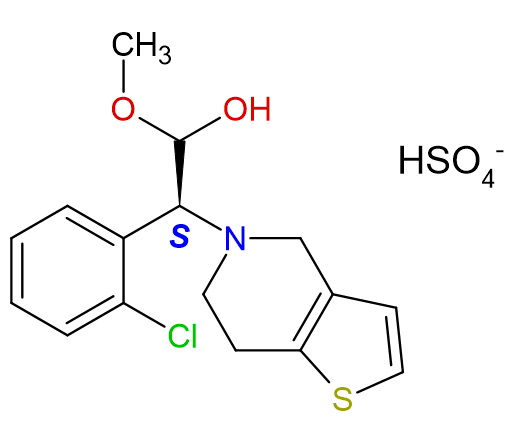
To illustrate the practical application of a multi-technique PoS strategy, a case study was performed on clopidogrel hydrogen sulfate, a widely used antiplatelet API. As the compound is a chiral salt, a combination of complementary analytical techniques was employed for structure confirmation and to unequivocally confirm its identity, solid-state form and stereochemistry.
Crystallinity, phase purity and definitive structural elucidation
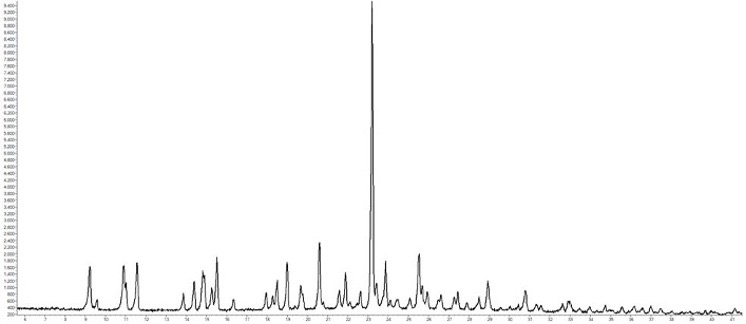
HR-XRPD analysis was first used to assess the crystallinity and phase purity of the sample. The diffraction pattern (designated Form A) showed sharp and well-defined diffraction peaks, indicative of a highly crystalline material. Indexing of the powder pattern confirmed consistency with the expected crystalline form of clopidogrel hydrogen sulfate, with no evidence of additional polymorphic phases or amorphous content. For a wider view of this technique, see x-ray powder diffraction in drug development.
To further confirm the three-dimensional arrangement of the molecule, SC-XRD analysis was performed. Suitable crystals were obtained through a controlled slow antisolvent crystallization experiment (MeOH/toluene 1/1). The resulting structure provided unambiguous confirmation of the molecular connectivity, stereochemistry and salt stoichiometry, including the correct protonation state and hydrogen sulfate counterion positioning. The analysis also confirmed the absolute configuration of the two chiral centers, with the C7 stereocenter assigned as S and the N12 stereocenter assigned as R. This technique served as the definitive method for structural confirmation.
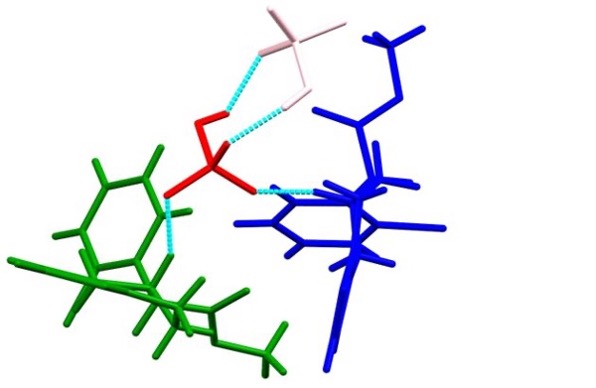
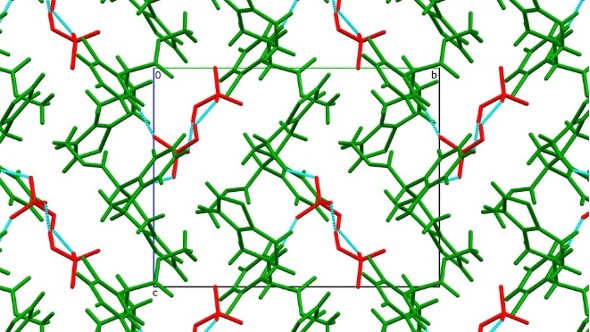
The simulated diffractogram derived from the single-crystal structure showed excellent agreement with the experimental powder pattern of the isolated crystal, confirming that both datasets correspond to the same clopidogrel hydrogen sulfate salt phase. In addition, Rietveld refinement was performed, allowing for validation of the structural model and phase quantification of the bulk material.
Thermal behavior and solvation state
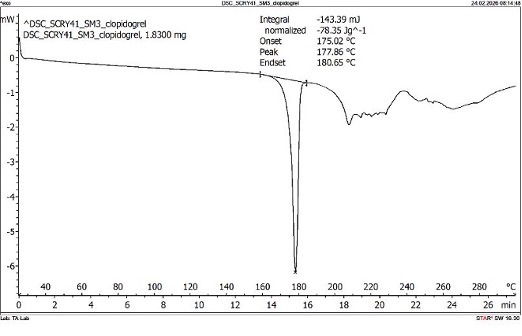
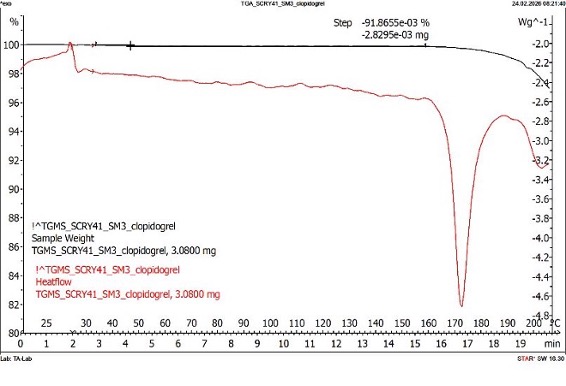
Thermal characterization was conducted using differential scanning calorimetry (DSC) and thermogravimetric analysis (TGA).
The DSC thermogram displayed a sharp endothermic event corresponding to the melting point, consistent with literature values, confirming the solid-phase purity and crystallinity of the material. Decomposition was observed concurrently with the melting process, indicating that the compound begins to decompose upon melting.
TGA analysis showed no significant mass loss prior to melting/decomposition, indicating that Form A is anhydrous. Together, these techniques elucidated the thermal behavior and solvation state of Form A.
Purity, molecular weight and salt stoichiometry
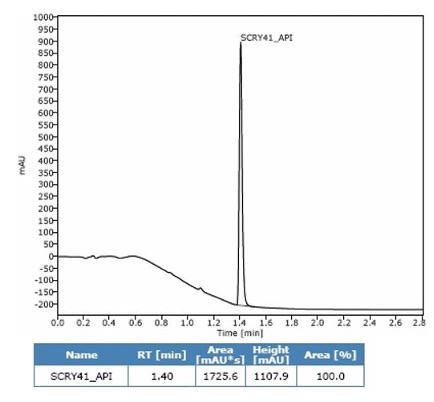
UPLC-MS analysis was performed to assess the impurity profile of the sample and further confirm the molecular identity. The chromatogram showed a dominant peak corresponding to clopidogrel, with high purity (100% area%). No significant impurities were detected.
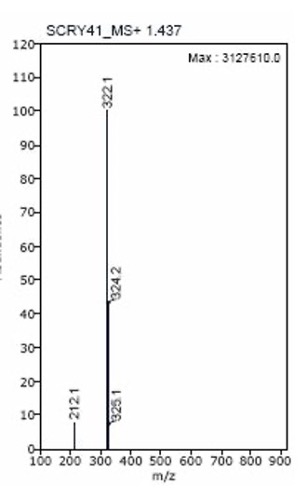
The MS spectrum of the API peak showed the molecular peak at 322.1 m/z, which likely corresponds to the positively charged species [M+H]⁺ (API MW: 321.8 g/mol). Mass spectrometry therefore provided the expected molecular ion, consistent with the proposed structure, thereby supporting the identity of clopidogrel.
UPLC-CAD analysis was applied to quantify the amount of hydrogen sulfate. The analysis confirmed the stoichiometric ratio of 1:1 between clopidogrel and hydrogen sulfate, supporting the salt stoichiometry assigned by SC-XRD.
Confirming molecular identity in solution
¹H-NMR spectroscopy was employed to confirm the molecular structure in solution. The total number of protons was consistent with the molecular formula, and the observed chemical shifts and multiplicities matched the proposed structure. One expected CH₂ signal was not directly observed, as it probably overlapped with the MeOH-d₄ solvent signal; this assignment is nevertheless supported by the overall spectral consistency and integration pattern. The absence of unexpected signals further supported the high chemical purity of the sample.
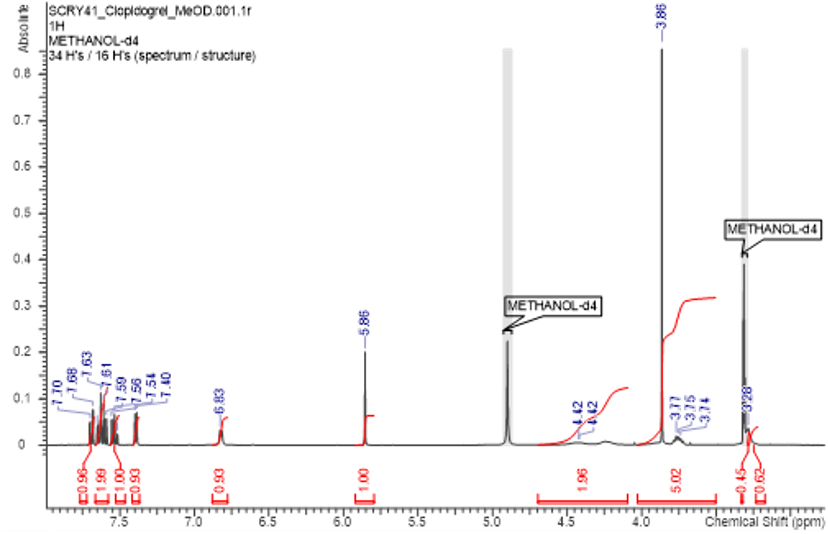
2D NMR data were also in line with the structure of clopidogrel hydrogen sulfate. The (partial) overlap between the residual solvent signal (MeOH-d₄) and one of the CH₂ resonances observed in the ¹H-NMR spectrum could be fully resolved in the HSQC spectrum.
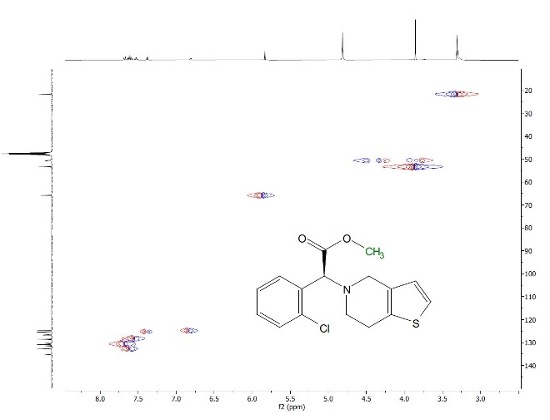
The ¹H and ¹³C NMR assignments are summarized in the table below:
| ¹H | δ (ppm) | ¹³C | δ (ppm) |
| CH₃ | 3.86 | CH₃ | 53.4 |
| CH₂ | 4.41, 4.22, 3.86, 3.74, 3.28 | CH₂ | 50.6, 21.2 |
| CH | 7.68, 7.63, 7.59, 7.52, 7.38 | CH | 132.7, 130.3, 128.6, 125.4, 124.9, 65.8 |
| Quaternary carbons | 167.2, 135.3, 131.5, 126.8, 126.7 |
Photosafety assessment
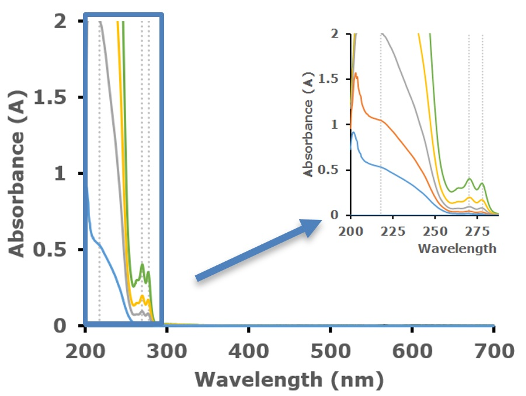
UV-Vis spectroscopy was used to evaluate the potential photosafety risk of clopidogrel hydrogen sulfate through determination of its molar extinction coefficient (MEC). According to ICH S10 Photosafety Evaluation of Pharmaceuticals, if a substance lacks an MEC greater than 1,000 L mol⁻¹ cm⁻¹ (between 290 and 700 nm), no photosafety testing is recommended and no direct drug phototoxicity is anticipated in humans.
UV-Vis absorbance was measured between 200–700 nm from a solution of clopidogrel hydrogen sulfate in methanol. Absorption maxima were observed at 218, 270 and 278 nm, with corresponding MEC values of 137·10², 5.85·10² and 4.72·10² L mol⁻¹ cm⁻¹, respectively. These results indicated that clopidogrel hydrogen sulfate is potentially non-photoreactive, and therefore no direct phototoxicity is anticipated in humans.
Conclusions
The combination of the analytical techniques at Ardena provides a comprehensive and highly reliable Proof of Structure. In this case study on clopidogrel, HR-XRPD confirmed phase purity, SC-XRD delivered definitive structural confirmation including absolute configuration, thermal analysis elucidated the thermal behavior and solvation state of Form A, NMR verified molecular identity in solution, and UPLC-based methods supported molecular weight determination, purity assessment and salt stoichiometry. Finally, UV-Vis spectroscopy indicated that clopidogrel hydrogen sulfate is potentially non-photoreactive and that no direct phototoxicity is anticipated in humans.
This case study demonstrates how a comprehensive analytical package can mitigate risk, provide complete confidence in the structural characterization of pharmaceutical compounds, and generate the robust analytical evidence required for regulatory submissions, including Investigational New Drug (IND) and New Drug Application (NDA) filings.
Related reading: structural confirmation for Module 3.
About this case study
This article is based on the Ardena application note “Proof of Structure: A Multi-Technique Approach to Confirm Molecular Identity” (version 1, 21 July 2026), Ardena Oss BV, Kloosterstraat 9, 5349 AB Oss, the Netherlands.
Subject Matter Experts

María Jesús Martín
Senior Scientist and Group Leader
María Jesús Martín is Senior Scientist and Group Leader in the Solid-State Department at Ardena Oss. She combines scientific expertise in solid-state science with project management experience across pharmaceutical development environments. Before joining Ardena in 2022, María Jesús began her career in solid-state science at Pharmorphix in Cambridge and later moved into project management roles within the pharmaceutical industry. At Ardena, she combines her scientific and project management background to support Solid-State Department activities and customer projects. María Jesús studied Chemistry in Zaragoza, Spain, and completed her MChem studies in Edinburgh, United Kingdom.

René Steendam
Director of Solid State Research
René Steendam is Director of Solid State Research at Ardena. He combines technical expertise in solid-state chemistry with experience in project management and business development across pharmaceutical development programs. Throughout his career, René has worked across both academia and industry, contributing to global pharmaceutical development projects with a focus on crystallization and solid-form development. He has authored more than 20 scientific publications and currently serves as Chairman of the Dutch Association for Crystal Growth (DACG). René obtained his PhD in Solid-State Organic Chemistry, specializing in crystallization and solid-form development.