


Tablets remain the way most of the world takes its medicine – yet developing a robust one is still surprisingly empirical. With the new STYL’ONE Evo Compaction Simulator at our Ghent site, we can now predict how a formulation will behave on a production tablet press or roller compactor from the very first development batch, using only grams of material.
Tablets are still how the world takes medicine
Oral solid dosage forms account for most medicines administered to patients, and tablets and capsules remain a major share of new drug approvals. However, developing a robust tablet can still be surprisingly empirical. A formulation that compresses well on a small laboratory press can cap, laminate or stick once it runs at production speed.
Discovering this late in development means repeat batches, lost material and lost time. The pressure is highest when a new API is scarce, expensive or highly potent, and when programs in areas such as oncology need to reach the clinic quickly.
How a compaction simulator works
A compaction simulator is a single-station press, comparable in layout to an eccentric tablet press. The difference lies in how its punches move.
On the STYL’One Evo, the upper and lower punches are each driven independently by planetary roller screws. This gives precise, reproducible punch positioning and allows the instrument to replicate the punch movement of a production rotary press. The powder then experiences the same compression speed, dwell time, pre-compression and main compression it would see in manufacturing, but on a single station and at a fraction of the material demand.
Every tablet produced generates continuous force and displacement data. From one small batch, our scientists can build a complete compaction profile of an API, excipient or blend, and answer the questions that decide whether a formulation will succeed:
- Can a strong enough tablet be made, and at what compaction pressure?
- Is the material plastic, brittle or elastic – and which excipients will complement it?
- Is there a risk of capping or lamination?
- Will ejection and lubrication run smoothly at production speed?
Choosing the STYL’One Evo: why it fits Ardena
Ardena chose the STYL’ONE Evo from Medelpharm (Korsch group). It is a well-established compaction simulator with a small footprint and an active international user community.
Its upper and lower punches are each driven by their own electromechanical drive, using planetary roller screws, which gives precise, reproducible punch control. The instrument can reproduce the punch movement of a production press, or follow a target force. Load cells and displacement sensors record the full compression, decompression and ejection profile of every tablet.
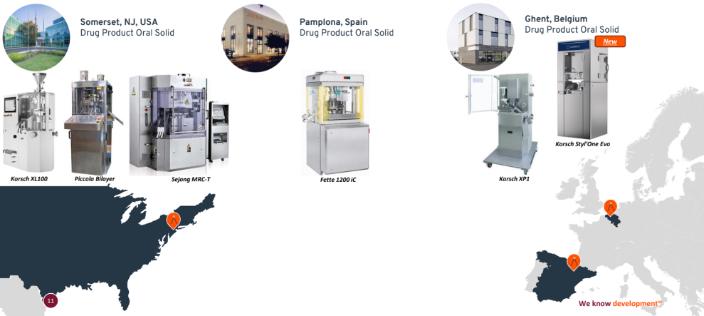
Built-in libraries cover Korsch rotary presses and other presses used across Ardena’s network, including the Fette 1200i, the Piccola bilayer and the Sejong MRC-T. They also cover the main roller compactor brands. As a result, a single instrument can mimic both the tablet press and the dry granulation equipment a formulation will eventually meet.
The simulator delivers compression forces of up to 50 kN and can produce up to 1,750 tablets per hour. It works with EU-B and EU-D tooling and has gravity and forced feeders. Up to three feeders allow multilayer and tab-in-tab tablets. An external lubrication system is already installed, and further modules can be added as projects require.
One instrument across the development lifecycle
Early formulation screening. Compressibility, compactibility and tabletability profiling ranks formulations objectively. It replaces “it made a tablet on the bench press” with data-based go/no-go decisions. Compaction models such as Heckel and Kawakita fingerprint the mechanical properties of a material, supporting data-driven decisions during development. They also help detect batch-to-batch differences in an API or excipient.
Process understanding. Design-of-experiment studies map how compaction pressure, tableting speed, dwell time, feeder settings and lubrication affect tablet quality. This moves development from trial and error towards Quality by Design, and it builds the process knowledge that regulators and manufacturing teams expect.
Scale-up and transfer. The STYL’ONE Evo carries a library of simulated compression profiles for Korsch presses, plus profiles for presses such as the Fette 1200i and Piccola bilayer presses (in-house presses at Ardena). Ardena can therefore run the compression cycle of the intended production press at lab scale. This shows whether a formulation will withstand high speed and which settings it would need, well before the first large batch and with a limited amount of material.
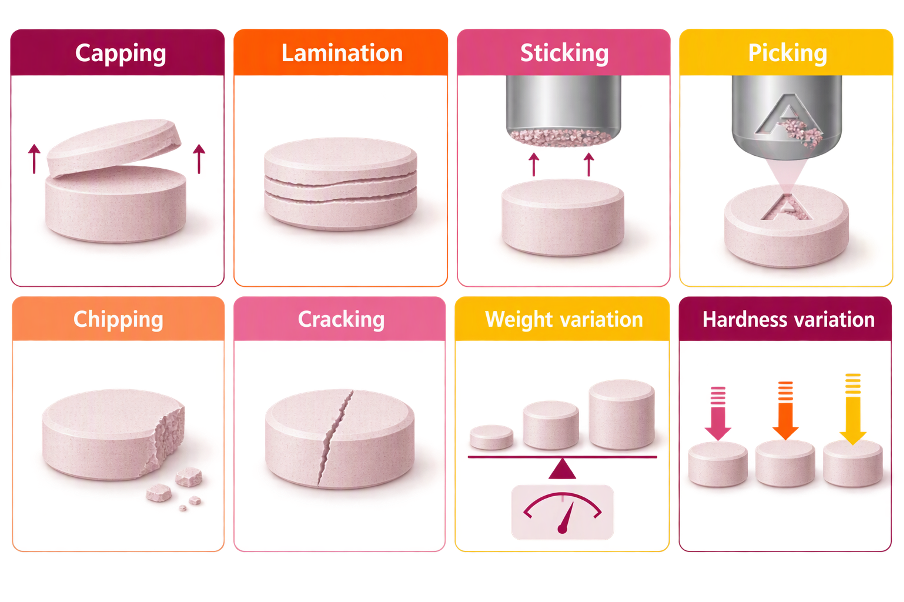
Troubleshooting and changes. Tablet defects such as capping, lamination, sticking, picking and weight or hardness variation can be reproduced and investigated at small scale using the actual powder and tooling. The same approach assesses what happens when something changes during a product’s life: a new excipient supplier, a faster press speed, a new punch design, or a transfer to another site or tablet press.
Dry granulation, too
The STYL’ONE Evo also simulates roller compaction. Using profiles for commercial roller compactors, including Alexanderwerk and Gerteis, it reproduces the compaction conditions between the rolls and makes simulated ribbons at a realistic solid fraction. Formulators can screen dry-granulation conditions and check how the resulting granules will tablet, with a fraction of the material and time a full roller compactor trial would need.
A modular platform
Beyond standard compaction, the platform includes:
- an external lubrication system, which applies lubricant to the tooling rather than blending it into the powder
- gravity and forced feeders
- multilayer tablets with up to three different blends, and tab-in-tab configurations
- a linear ejection system for minitablets and shaped tablets
- an in-line link to a tablet tester
Less material, more insight, faster to patients
The common thread across all these applications is simple: a wealth of information from a small amount of material. Fewer trial batches mean lower API consumption and lower development cost. Better understanding of scale-up makes technology transfer smoother and reduces the risk of quality issues in manufacturing. Together, that shortens the path from preclinical development to the clinic, and ultimately to patients.
The data also has value beyond a single project. Compaction simulator data can feed predictive and data-driven formulation models, which are becoming increasingly important as the industry looks to develop medicines with less material and fewer experiments.
Part of Ardena’s oral solid dosage network
The simulator links Ardena’s tableting and roller compaction capabilities across Ghent (Belgium), Pamplona (Spain) and Somerset, NJ (USA). Because its profile libraries cover the presses and roller compactors used across the network, development work in Ghent translates directly into manufacturing at Ardena’s other sites.
Key takeaways
With the STYL’One Evo, Ardena can fingerprint a material, understand the process and predict scale-up from just a few grams of powder. It can also reproduce production problems at small scale and support dry granulation development on the same platform. The result is less API, fewer trial batches and a faster, more robust path to the clinic.
Developing an oral solid dosage form? Contact our formulation team to find out how compaction simulation can de-risk your program.
Subject Matter Experts

Laure Descamps
Senior Formulation Scientist
Laure Descamps is Senior Formulation Scientist at Ardena, specializing in solid dosage development and process understanding. She supports formulation design, process optimization, and early-phase drug product development for complex pharmaceutical programs. At Ardena, Laure applies her expertise to developing robust formulation strategies that support the efficient advancement of complex molecules toward clinical evaluation. Her work focuses on formulation development and process understanding across early-stage drug product development activities. Laure obtained her Master’s degree in Drug Development and Industrial Pharmacy and earned her PhD from Ghent University’s Laboratory of Pharmaceutical Process Analytical Technology. Her doctoral research focused on tableting behavior, material characterization, and compression challenges in collaboration with industry partners.