


HPAPI contract manufacturing companies are not interchangeable, and choosing the right one is among the highest-stakes decisions in a potent-compound program.
Pick the wrong partner and it surfaces later: as a containment finding, a failed cleaning validation, or a technology transfer that stalls before your first batch.
This guide is about how to make that choice well, covering the criteria, trade-offs and questions that separate a genuinely capable partner from a persuasive sales deck. It is deliberately not a description of what any one provider makes.
Start with containment you can verify, not containment that is claimed
Potency is classified using occupational exposure banding, the industry framework that sorts compounds by how hazardous they are to handle. It runs from band 1, the least hazardous, to band 5, the most potent, and some classification systems add a sixth band for ultra-potent conjugates.
Band 4 covers compounds with an occupational exposure limit between roughly 1 and 10 micrograms per cubic meter of air, and band 5 covers those below 1 microgram, the point at which standard suites can no longer protect operators or reliably prevent cross-contamination.
From band 4 upward, containment, cleaning and trace-level analysis all have to be purpose-built. The band your molecule sits in dictates the engineering a partner actually needs: sealed isolators and closed transfers, not respirators and written procedures.
Ask every shortlisted provider for documented surrogate containment test data at your band, generated at the specific site that would run your program rather than a corporate average.
A clean inspection record and containment evidence at the exact facility that will make your batches matter more than a global footprint.
A partner that treats containment designed in from the start as an engineering discipline is far more defensible, to regulators and to your pharmacovigilance team, than one that leans on protective equipment.
Match the partner to your molecule and its stage
Potency rarely travels alone. Many potent compounds are also poorly soluble, structurally complex, or destined to become a conjugate, and each raises a different question.
For a difficult route, ask how a provider approaches the efficient synthesis of highly potent compounds at contained scale, and whether one team can carry the chemistry from milligrams to kilograms without a mid-program site change. If your molecule is a payload or linker, generic potent-handling experience is not enough, so look for dedicated ADC and XDC programs.
If you need drug substance, probe the depth of their HPAPI synthesis record for compounds like yours. Start this conversation before the chemistry is locked; early input from a partner with high potency and controlled substances experience can shape a route that is easier and safer to contain later.
Treat cleaning validation as a patient-safety question
Where equipment is shared, cleaning validation is what protects the next patient from your compound.
Confirm that acceptance limits come from compound-specific health-based exposure limits set by a qualified toxicologist, not legacy parts-per-million rules, and that the analytical method can reliably detect residues below the calculated carryover.
Then ask whether your compound would run on dedicated or campaign equipment, and what that means for scheduling and cross-contamination risk.
Look beyond the suite: supply chain and change control
Two factors that buyers routinely underweight sit outside the containment suite. The first is starting-material and supply-chain transparency.
For compounds built through complex multi-step synthesis or controlled precursors, a partner’s ability to source, qualify and document those materials affects both regulatory risk and continuity of supply, and reshoring pressure has turned provenance into a live question rather than a formality.
The second is change control. A manufacturing change at your partner’s site can trigger a regulatory variation for your own product, so ask how changes are assessed, communicated and timed, and whether the site’s change history has ever caused a quality problem.
Questions that separate capability from a sales deck
When you compare HPAPI contract manufacturing companies side by side, the differences that matter rarely appear on the capability slide. These do:
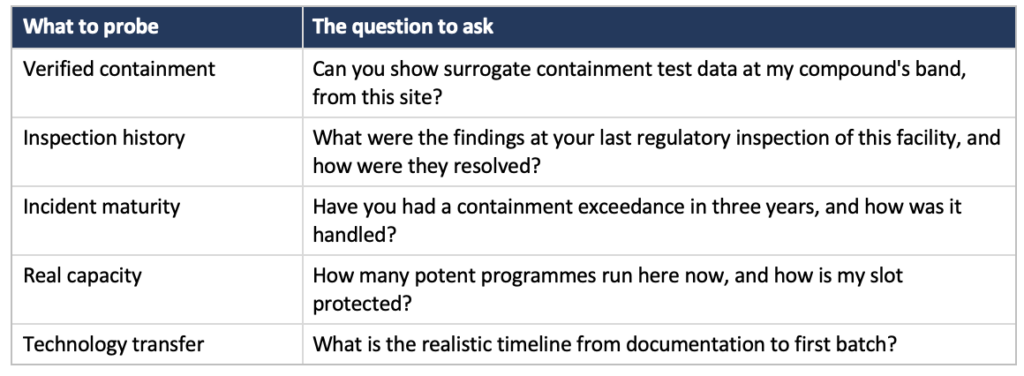
The questions buyers most often skip are the human ones: who your project manager is, what happens when they leave, and how the site resolves competing priorities when a larger client wants the same suite the same week. For the quality-system and project-management ground that applies to any first manufacturing campaign, our due diligence checklist for Phase I CDMO selection is a useful companion to this guide.
The bottom line
The right partner is the one whose evidence matches your molecule’s band, stage and complexity, and who shows you the data before you have to ask twice. Ardena publishes that evidence for its own high potency site: occupational exposure measurements with a model compound, four segregated suites, and a facility that has passed every regulatory inspection since 2012.
Related reading
Encapsulating Challenging APIs: High Potency and Low Solubility