
Data Integrity in GMP Manufacturing: What ALCOA+ Means in Practice

The Most Common Route to a Warning Letter

Data integrity findings are now the single most frequently cited category in FDA warning letters to pharmaceutical manufacturers. That was not true fifteen years ago. It has become true as manufacturing has digitised, regulators have become more forensically capable, and the consequences of data manipulation have become better understood.

The problem is not always deliberate fraud. Some of the most damaging data integrity findings involve systems that were poorly designed, electronic records that did not generate adequate audit trails, or paper-based practices that made retroactive correction too easy. The intention may have been innocent. The regulatory consequence is the same.

What ALCOA+ Actually Means

ALCOA is the foundational data integrity framework used by regulators globally. The FDA’s guidance on data integrity and compliance with CGMP and the EMA’s guideline on data integrity in GMP regulated environments both reference it. ALCOA+ extends the original five principles with four additional attributes.

PrincipleWhat It RequiresCommon Failure Mode
AttributableEvery data entry must be traceable to the person who made it and the time it was madeShared login credentials; no timestamp on handwritten entries; analyst initials missing
LegibleRecords must be readable permanently; corrections must not obscure the original entryCorrection fluid (Tipp-Ex) used on paper records; overwriting rather than single strikethrough
ContemporaneousData must be recorded at the time the action is performed, not reconstructed laterBatch records completed from memory after the event; worksheet data transferred to official record hours later
OriginalThe first recording of data is the original; it must be preservedRaw analytical data deleted after transcription; original printouts discarded
AccurateData must reflect what actually happenedValues rounded to meet specification; results selectively excluded without justification
Complete (+)All data, including invalidated runs and out-of-trend results, must be retainedDeleted HPLC injections not captured in audit trail; only passing results forwarded for review
Consistent (+)Processes must be applied the same way every timeOOS investigations applied differently depending on whether the result affects batch disposition
Enduring (+)Records must be stored for the required retention period in a readable formatElectronic records in obsolete formats; backup systems not validated
Available (+)Records must be accessible to the relevant personnel and to inspectors when requiredRecords stored offsite without retrieval procedure; electronic systems unavailable during inspection

The Audit Trail: Where Most Data Integrity Problems Hide

Modern computerised systems generate audit trails automatically. Every action taken in the system, every entry, every modification, every deletion, is recorded with a timestamp and a user ID. If the system is properly configured and the audit trail is routinely reviewed, data integrity problems are caught early.

If the audit trail is not reviewed, problems accumulate invisibly until an inspector reviews it during an inspection and finds patterns that suggest manipulation. Deleted runs. Repeated injections after failing results. Entries made at times inconsistent with the production schedule. These patterns are exactly what regulators look for.

Routine audit trail review, by supervisors and by quality oversight, is not an optional activity. It is a core GMP control.

Paper vs. Electronic Records: The Practical Risks of Each

Paper Records

Paper records are not inherently less secure than electronic ones, but they carry specific risks. Corrections are easy to make, and the standard for compliant correction (single line through the error, initials, date, reason) is frequently not followed. Records can be lost, damaged, or retrospectively completed. Handwriting is sometimes illegible. None of these are evidence of fraud, but all of them can generate data integrity findings.

Electronic Records

Electronic systems introduce different risks. Shared login credentials mean that attributability is lost. Audit trail review is neglected. Electronic data is backed up to unvalidated systems. Spreadsheets are used for GMP calculations without access controls or formula protection. The sophistication of the system does not guarantee the integrity of the data if the controls around it are inadequate.

What a Data Integrity-Mature Manufacturing Partner Looks Like

A CDMO with a genuine data integrity culture does not wait for inspections to review audit trails. Its quality oversight routinely checks that records are contemporaneous, that analytical runs are complete, and that any deviations from the expected pattern are investigated rather than rationalised. Its training programmes cover data integrity specifically, not just as a module in a GMP overview, but as a standalone topic with case studies and practical application.

When evaluating a CDMO, asking specifically about audit trail review procedures and data integrity training is a legitimate and revealing due diligence question.

Ardena’s Approach to Data Integrity

Data integrity controls at Ardena are embedded in the quality management system across all sites, covering both paper-based batch records and electronic systems including LIMS, chromatography data systems, and manufacturing execution systems. Audit trail review is built into the quality oversight programme, and data integrity is addressed in site training as a distinct topic.

From Development Batch to GMP: The Process Scale-Up Journey

Why Scale-Up Surprises Happen

The development laboratory is a controlled, forgiving environment. The scientist is present at every step, making small adjustments and observations that never make it into the batch record. The equipment is flexible. The batch size is small enough that a failed experiment costs almost nothing.

GMP manufacturing is the opposite. The process must be executed by operators following a fixed procedure, using equipment that may differ substantially from the development kit, in a regulated environment where every deviation generates a quality event. The tacit knowledge the development scientist held in their head is not available at the manufacturing scale.

Scale-up failures are not usually caused by poor science. They are caused by the gap between what was understood about the process and what was written down.

The Most Common Scale-Up Failure Modes

Failure ModeWhat Causes ItHow to Prevent It
Blend uniformity lossMixing dynamics differ between lab and GMP blenders; segregation occurs at larger scaleCharacterise blend uniformity at intermediate scale; define blend time and speed as critical process parameters
Granule size distribution shiftHigh-shear granulators at GMP scale apply different shear profiles; impeller geometry differsRun granulation at intermediate scale; define wet mass endpoint by torque or power consumption rather than time
Tablet hardness and friability out of rangeCompression force requirements differ at GMP scale; punch tooling geometry may differRun a compaction simulation on the GMP press before the GMP batch; define compaction force range with in-process controls
Dissolution failureParticle size distribution of API or granules shifts at scale; compression force affects tablet porosity and dissolutionConfirm dissolution at each scale; link dissolution to particle size and compaction parameters
Coating defectsPan geometry and air volume differ at scale; spray rate and atomisation pressure need re-optimisationDevelop coating parameters using scale-up relationships; run scale-up trial before GMP batch if possible
Yield lossProcess losses at each step accumulate; GMP equipment dead volumes are largerMap equipment dead volumes; adjust batch size to account for losses; define acceptable yield range

Scale-Up Is a Scientific Activity, Not Just an Operational One

The most common mistake in scale-up is treating it as a task for the manufacturing team rather than for the formulation scientists. The manufacturing team knows how to run the equipment. The formulation scientists know why each parameter matters and what the process is sensitive to. Both are needed.

The practical outcome of good scale-up science is a set of documented critical process parameters (CPPs) with defined acceptable ranges, and a clear link between those parameters and the critical quality attributes of the product. That link, the process understanding that connects what you do to what you get, is what process validation is built on.

The Role of Design of Experiments in Scale-Up

Design of experiments (DoE) is the systematic approach to understanding how process parameters interact to affect product quality. Rather than changing one variable at a time, DoE changes multiple variables in a structured pattern that allows their individual effects and interactions to be quantified efficiently.

For scale-up, DoE at the development or intermediate scale builds the process understanding that makes GMP-scale manufacturing predictable. A team that has run a DoE mapping the effects of granulation endpoint, drying temperature, and blending time on granule properties arrives at the GMP scale with a model of the process, not just a set of fixed instructions.

Process Validation: What Regulators Expect

The FDA’s process validation guidance describes a lifecycle approach with three stages: process design (where development knowledge is captured), process qualification (where the commercial-scale process is confirmed to perform consistently), and continued process verification (where ongoing monitoring confirms that the validated state is maintained). For clinical supply, the same thinking applies, though the formal process validation is typically deferred to the commercial stage.

At the GMP clinical batch stage, the expectation is that the process is sufficiently understood that the batch is manufactured according to a defined process with identified critical steps and controls, and that any deviations are investigated meaningfully. The process understanding accumulated during scale-up is what makes that possible.

How Ardena Manages Scale-Up at Ghent

Ardena’s oral solid development and manufacturing team at Ghent conducts development, intermediate-scale, and GMP manufacturing at the same site. Formulation scientists remain involved in the GMP manufacturing phase, providing the scientific context that operators need when unexpected results arise. The team documents process understanding progressively through development, building the CPP and CQA linkages that support both the manufacturing process and the CMC regulatory filing.

GMP Deviations: How to Investigate, Resolve, and Prevent Them

Deviations Are Not the Problem. The Response Is.

In any GMP manufacturing environment, deviations will happen. A process parameter drifts outside its validated range. A raw material fails an incoming test. A batch record is completed incorrectly. These events are not evidence of a dysfunctional organisation. They are the normal noise of complex manufacturing.

What matters is what happens next. A deviation that is investigated thoroughly, attributed to a genuine root cause, and closed with a corrective action that actually prevents recurrence is a system working as it should. A deviation that is closed with a vague root cause and a CAPA that amounts to retrain the operator is a system generating paperwork, not quality.

Regulators know the difference. So do sponsors reviewing their CDMO’s quality metrics.

The Deviation Life Cycle

StageWhat HappensCommon Failure Mode
DetectionOperator or automated system identifies an event outside expected parametersDetection delayed because monitoring is inadequate or parameters are not well defined
Immediate containmentAffected material quarantined; process halted if necessary; batch placed on holdProduction continues before the scope of the deviation is understood
Initial assessmentQuality unit classifies severity; determines whether batch can continueSeverity underestimated; critical deviation treated as minor to avoid disruption
Root cause investigation5-Why analysis, fishbone diagram, or fault tree analysis identifies the underlying causeRoot cause attributed to human error without investigating why the error occurred
Impact assessmentAll potentially affected material and batches are reviewedImpact assessment limited to the single batch; historical batches not reviewed
CAPA developmentCorrective action addresses root cause; preventive action reduces recurrence riskCAPA is procedural (update the SOP) rather than systemic (fix the system that allowed the deviation)
Effectiveness checkCAPA is verified to have worked after implementationEffectiveness check not scheduled; CAPA closed before evidence of effectiveness gathered

Root Cause Analysis: Beyond Human Error

The most common root cause in pharmaceutical deviation investigations is human error. It is also the least useful root cause attribution there is.

Attributing a deviation to human error tells you nothing about why that error occurred or how to prevent it. It closes the investigation without answering the real question. Was the procedure unclear? Was the operator undertrained? Was the workstation poorly designed? Was there time pressure that encouraged shortcuts? Was the check system inadequate?

A genuinely useful root cause investigation works backwards from the event through the contributing factors to the system-level condition that made the error possible. That is the condition that needs to be fixed.

Out-of-Specification (OOS) Results: A Special Category

An out-of-specification analytical result requires a specific investigation process governed by the FDA’s guidance on OOS results and EU GMP Chapter 6 on quality control. The process has two phases: a laboratory investigation to determine whether the OOS result is a genuine product failure or a laboratory error, followed by a full-scale investigation if the laboratory phase cannot identify an assignable cause.

The distinction matters because the two scenarios have different consequences. A laboratory error that is identified and confirmed allows the original sample to be retested (with restrictions). A genuine OOS result triggers a full investigation including review of the manufacturing record, assessment of related batches, and a decision about batch disposition.

Invalidating an OOS result without a confirmed, documented, and justified assignable laboratory cause is a major regulatory finding. Inspectors specifically look for OOS investigations where the outcome was invalidation without adequate justification.

CAPA: The System That Should Drive Improvement

Corrective and preventive action (CAPA) is the mechanism by which deviations feed back into the quality system and generate genuine improvement. A well-managed CAPA system tracks the status of all open actions, links CAPAs to their originating deviations, and monitors whether closed CAPAs have actually achieved their intended effect.

The most common CAPA failure mode is the procedural fix. The batch record instruction was unclear, so the CAPA is to update the batch record instruction. This may be necessary, but it is rarely sufficient. If an operator did not follow a clear instruction, the question is why. If the instruction was genuinely unclear, the deeper question is why it was unclear and how other instructions in the same system should be reviewed.

How Ardena Manages Deviations Across Its Network

Ardena’s quality management system applies consistent deviation investigation and CAPA standards across all sites, with centralised oversight of quality metrics and trend analysis. Sponsors receive timely notification of deviations affecting their programmes and have visibility into the investigation timeline and closure status through the programme’s quality governance structure.

High Potency API Manufacturing: Safety by Design

What Makes a Compound High Potency?

The term high potency active pharmaceutical ingredient (HPAPI) refers to any compound with significant biological activity at very low doses, typically below 1 milligram per day in humans, or with occupational exposure limits in the microgram per cubic metre range. The category includes cytotoxic oncology agents, hormonal compounds, certain immunosuppressants, and novel targeted therapies with high receptor affinity.

The manufacturing challenge with HPAPIs is not the chemistry itself, which may be no more complex than for conventional APIs, but the containment required to protect operators and the environment from exposure to a compound that causes harm at extremely low concentrations. The engineering controls, facility design, and operational procedures needed to handle HPAPIs safely are substantially different from those applicable to conventional pharmaceutical manufacturing, and they must be in place before any GMP manufacturing campaign begins.

The Occupational Exposure Banding Framework

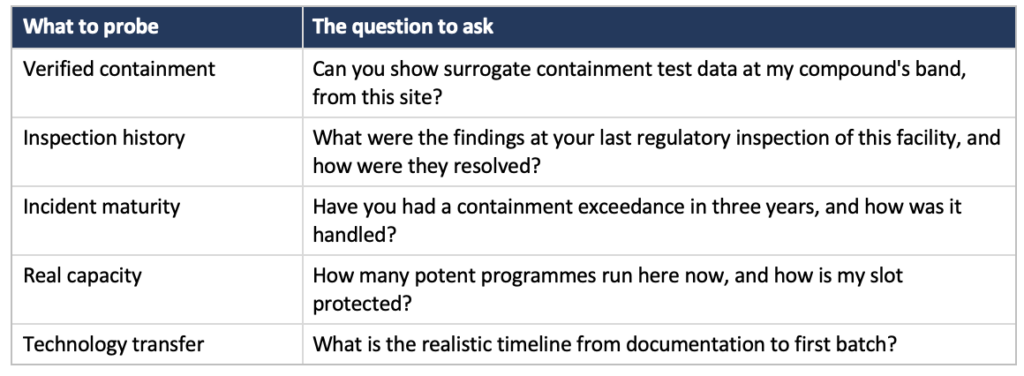
Occupational exposure banding (OEB) is the standard industry framework for classifying the hazard of a pharmaceutical compound based on its potency, toxicology profile, and pharmacological activity, and for defining the corresponding engineering controls required for safe handling. The ISPE guide to risk-based manufacture of pharmaceutical products and guidance from the American Industrial Hygiene Association (AIHA) provide frameworks for OEB classification. Most CDMOs use a five-band or six-band system, with Band 4 and Band 5 requiring the most stringent containment.

OEB BandOEL Range (8-hour TWA)Typical Compound TypesRequired Containment Level
OEB 1Greater than 1 mg/m3Conventional APIs with low hazardStandard pharmaceutical engineering controls
OEB 20.1 to 1 mg/m3APIs with moderate potencyLocal exhaust ventilation; PPE
OEB 30.01 to 0.1 mg/m3Potent APIs; some hormonesClosed or semi-closed processing; enhanced PPE
OEB 40.001 to 0.01 mg/m3 (1 to 10 micrograms/m3)Cytotoxics; HPAPIs; most ADC payloadsContainment isolators or RABS; dedicated facilities or rigorous decontamination
OEB 5Below 0.001 mg/m3 (below 1 microgram/m3)Genotoxic compounds; highly potent cytotoxics; TCDD-like compoundsDedicated facility; full containment isolators; continuous air monitoring; stringent decontamination validation

OEL ranges above represent typical band definitions and may vary between organisations and classification systems. Compound-specific OELs should always be established by qualified industrial hygienists.

Engineering Controls: The Hierarchy of Protection

The occupational health principle of the hierarchy of controls applies directly to HPAPI manufacturing. Elimination and substitution are rarely options for an API that is the entire point of the product. Substitution with a less hazardous alternative may be possible at the discovery stage but not at the development stage. Engineering controls, specifically containment technology, are therefore the primary means of protecting operators.

Closed Handling Systems

At OEB 3 and lower OEB 4, closed handling systems including contained transfer systems and split butterfly valves allow material to be transferred between vessels and equipment without operator exposure. These systems are widely used in pharmaceutical manufacturing for potent materials and do not require a dedicated facility.

Containment Isolators

For OEB 4 and OEB 5 compounds, manufacturing operations must be conducted inside containment isolators: sealed enclosures with integrated glove ports that allow operators to manipulate materials inside without direct contact. Isolators maintain negative pressure relative to the surrounding environment, ensuring that any leak is inward rather than outward. Decontamination of the isolator between campaigns is typically achieved using hydrogen peroxide vapour or other validated decontamination agents.

Facility Design

At the highest potency levels, dedicated facilities with separate HVAC systems, airlocks, and personnel decontamination facilities are required. The facility must be validated to demonstrate that decontamination procedures achieve adequate removal of the compound from surfaces and that the HVAC system prevents cross-contamination with less potent products. Continuous environmental monitoring for HPAPI compounds in work area air is standard practice at OEB 4 and 5.

Process Design for HPAPI Manufacturing

Containment is not only about the physical infrastructure. The manufacturing process itself must be designed to minimise the number of open handling steps, reduce the generation of dust and aerosols, and simplify the decontamination requirements. Process design considerations for HPAPI manufacturing include using wet granulation rather than dry granulation where the API is amenable, minimising the number of charging and discharging operations, and using in-line or at-line analytical methods that do not require sample removal from the contained environment.

Ardena’s HPAPI Manufacturing Capability at Pamplona

Ardena’s Pamplona (Idifarma) facility in Spain provides OEB 3, 4, and 5 manufacturing capability for high potency API and drug product development and GMP manufacturing. The site is equipped with containment isolators for handling at the highest potency levels, dedicated HPAPI suites with appropriate HVAC segregation, and validated decontamination procedures.

Pamplona’s HPAPI capability supports both drug substance synthesis and drug product manufacturing for oral solid and injectable dosage forms, covering the full manufacturing chain for oncology compounds, ADC payloads, and other high-potency molecules from pre-GMP development through to clinical batch supply.

Continuous Manufacturing in Oral Solids: Is Your Product a Candidate?

Beyond the Batch Paradigm

Pharmaceutical tablet manufacturing has been batch-based for most of its history. Raw materials in, process step by step, finished product out, test and release. The batch is a defined, auditable unit of production with a clear beginning and end.

Continuous manufacturing challenges that model. Materials flow through an integrated process train without stopping: blending, granulation, drying, tabletting, and coating happen in sequence, in real time, monitored by inline sensors that provide a continuous stream of data on the product being made. There is no batch in the traditional sense. There is a time-defined unit of production, characterised by the process data collected during its manufacture.

The FDA has actively encouraged this transition. Its 2019 guidance on pharmaceutical quality for continuous manufacturing and the ICH Q13 guideline both provide frameworks that make continuous manufacturing a viable regulatory pathway for new products.

The Real Advantages of Continuous Over Batch

Smaller Footprint, Faster Output

A continuous manufacturing line produces tablets at a defined throughput rate, typically measured in kilograms per hour. To increase output, you run the line for longer, not build a bigger facility. For clinical supply, this means small campaigns can be run efficiently without the scale-up losses inherent in batch tabletting. For commercial supply, it means flexible throughput without capital investment in larger equipment.

Better Process Understanding

Because continuous manufacturing relies on real-time sensors, the process data generated per batch equivalent is orders of magnitude richer than in conventional manufacturing. Blend uniformity, particle size, tablet hardness, and dissolution are all monitored continuously rather than sampled at fixed intervals. This data density enables faster identification of process drift and more rapid root-cause analysis when deviations occur.

Reduced Scale-Up Risk

In batch manufacturing, scaling from a development batch to a commercial batch means different equipment, different shear forces, different mixing dynamics. In continuous manufacturing, the same equipment runs at the same process parameters regardless of the total batch size. Scale-up is a matter of runtime, not equipment change. That removes one of the most unpredictable phases of pharmaceutical development.

Is Your Product a Candidate? A Practical Checklist

FactorFavourable for Continuous ManufacturingLess Favourable
API flow propertiesGood to moderate flowability; amenable to loss-in-weight feedingVery poor flow; tendency to bridge or rat-hole in feeders
Blend sensitivityBlend uniformity maintained under continuous mixing conditionsVery segregation-prone blends; sticky or cohesive powders
Granulation requirementDirect compression or dry granulation preferred; wet granulation possible on integrated linesProducts requiring aqueous wet granulation with long drying times
Dose and tablet sizeMid-range doses; standard tablet geometriesVery low dose (microgram range) where blend uniformity at feeder level is challenging
Development stageNew development with flexibility to design process for continuous manufacturing from the startEstablished batch process with significant existing clinical data package
Regulatory timelineSufficient time to generate continuous manufacturing process data for CMC filingAccelerated timeline where batch process is faster to validate

The Regulatory Pathway for Continuous Manufacturing

ICH Q13, finalised in 2022, provides the harmonised guidance for continuous manufacturing of drug substances and drug products. It addresses the definition of batch, the control strategy for continuous processes, the use of PAT tools for real-time release, and the stability data requirements. The FDA’s own guidance on continuous manufacturing complements Q13 with US-specific expectations on process validation and real-time release testing.

For sponsors considering continuous manufacturing for a new programme, engaging with the regulatory agency early, through a Type B meeting with the FDA or a scientific advice procedure with the EMA, is the most reliable way to confirm that the proposed control strategy and batch definition approach will be accepted before significant development investment is made.

Ardena’s Oral Solid Manufacturing Capabilities at Ghent

Ardena’s oral solid manufacturing team at Ghent has both batch and continuous manufacturing capability, with experience developing control strategies and CMC packages that meet the regulatory expectations for both approaches. The team can advise on whether a specific product profile is suited to continuous manufacturing and help design a development programme that builds the process understanding needed for a regulatory filing.

Process Analytical Technology (PAT) in Tablet Manufacturing

The Problem with Testing at the End

Traditional pharmaceutical manufacturing is built around the idea of testing finished product. You make a batch, you sample it, you test it, and you decide whether it passes. The problem is that by the time you know a batch is out of specification, you have already used the time, materials, and manufacturing capacity to make it. Rejection at the end of the process is expensive. For complex drug products, it can be catastrophic.

Process analytical technology (PAT) flips that model. Instead of testing the finished product, you monitor the process in real time and make adjustments before problems develop. The batch still gets tested for release, but the data generated during manufacture gives you confidence before you even run the final tests.

The Core PAT Tools in Oral Solid Manufacturing

Near-Infrared Spectroscopy (NIR)

NIR is the most widely implemented PAT tool in tablet manufacturing. It works by shining near-infrared light onto a powder or granule blend and measuring the wavelengths absorbed. Because different chemical bonds absorb at characteristic wavelengths, the resulting spectrum is a fingerprint of the material’s chemical composition. With appropriate calibration models, NIR can measure blend uniformity in real time during mixing, detect the endpoint of a granulation process, and confirm coating uniformity during film coating.

NIR does not require sample preparation or consumables, and it can be implemented as a non-contact measurement that does not disturb the process. Those properties make it well suited to continuous monitoring applications in blending and coating.

Raman Spectroscopy

Raman provides complementary chemical information to NIR and is particularly useful for monitoring polymorphic form in real time. Because different polymorphs of the same API have distinct Raman spectra, a probe positioned in a dryer or granulator can detect whether the solid form is changing during the process. For APIs that are prone to polymorphic conversion under the heat and humidity conditions of wet granulation, real-time Raman monitoring provides a direct safety net.

Particle Size Analysers

Focused beam reflectance measurement (FBRM) uses a scanning laser to measure the chord length distribution of particles in suspension or slurry in real time. In wet granulation, it provides continuous data on how granule size is evolving during the granulation process, allowing the endpoint to be determined from the particle size profile rather than from a fixed time or a grab sample.

PAT in the Regulatory Framework

Regulatory DocumentRelevance to PAT
ICH Q8(R2) Pharmaceutical DevelopmentIntroduces design space and Quality by Design concepts that PAT supports; encourages understanding of process-property relationships
ICH Q10 Pharmaceutical Quality SystemPromotes continual improvement; PAT data feeds directly into process monitoring and improvement programmes
FDA PAT Guidance (2004)Established the FDA’s position that PAT is encouraged and that real-time release testing can replace end-product testing where appropriate
EMA Reflection Paper on PATAligns with FDA position; supports use of NIR and other inline tools in EU GMP environments
ICH Q13 Continuous ManufacturingPAT is foundational to continuous manufacturing; real-time monitoring required for process control in continuous processes

Real-Time Release Testing: The Regulatory Endgame

The ultimate application of PAT in pharmaceutical manufacturing is real-time release testing (RTRT): replacing traditional end-product testing with a combination of inline process data and reduced end-product testing that together provide equivalent or greater assurance of product quality. ICH Q8(R2) explicitly supports RTRT as an outcome of Quality by Design development. For blend uniformity in particular, the FDA has accepted NIR-based RTRT as a replacement for conventional powder sampling and HPLC analysis in several approved products.

Implementing RTRT requires robust calibration models, validated PAT methods, and a clearly defined control strategy that specifies how real-time data is used in batch disposition decisions. It is not a shortcut, but it produces better process understanding and more robust manufacturing than conventional end-point testing alone.

PAT Capability at Ardena Ghent

Ardena’s oral solid manufacturing team at Ghent uses PAT tools including NIR spectroscopy and particle size analysis as part of its development and manufacturing programmes. The team has experience developing NIR calibration models for blend uniformity and granulation endpoint determination, and integrating PAT data into the process understanding and control strategy documentation required for CMC regulatory filings.

Scaling LNP Production: From Lab Bench to GMP Manufacturing

The Scale-Up Challenge Specific to LNPs

Scale-up is a challenge in pharmaceutical manufacturing generally, but it is a particularly acute challenge for lipid nanoparticle products. For a conventional tablet, scaling from a 1 kilogram development batch to a 100 kilogram GMP batch involves larger equipment with similar operating principles, and the scale-up relationships, though not always straightforward, are well understood from decades of industrial experience.

For LNPs manufactured by microfluidics, the situation is different. Microfluidic devices work by mixing two streams, an organic phase containing the lipids and an aqueous phase containing the nucleic acid payload, at controlled flow rates and flow rate ratios in a microchannel. The particle size and size distribution depend critically on the mixing characteristics within the channel, which are determined by the fluid dynamics at the specific flow rates and channel geometry used. Changing the scale of the process means changing the equipment, which changes the fluid dynamics, which can change the product.

Microfluidics Scale-Up: The Key Variables

Scale VariableEffect on LNP PropertiesScale-Up Strategy
Total flow rateHigher flow rates increase mixing efficiency but can increase shear stress on particlesMaintain flow rate ratio (FRR) constant; scale total flow rate with batch size using parallel channels or larger devices
Flow rate ratio (FRR)Primary determinant of initial particle size: higher aqueous:organic ratio gives smaller particlesKeep FRR constant across scales; validate that target particle size is achieved at each scale
Mixing geometryDifferent microfluidic chips produce different mixing regimes; particle size can differ between chip typesQualify each chip type at target scale; use manufacturer scale-up data as starting point
Lipid concentration in organic phaseHigher lipid concentration can increase particle size and polydispersityOptimise lipid concentration at development scale; confirm at GMP scale before batch manufacture
mRNA concentration in aqueous phaseAffects N:P ratio and encapsulation efficiencyKeep N:P ratio constant; calculate mRNA concentration to maintain N:P at target
Post-mixing dilution and buffer exchangeBuffer exchange by tangential flow filtration (TFF) affects particle stability and formulation pHValidate TFF parameters (transmembrane pressure, cross-flow rate) at each scale; monitor particle size through TFF

Tangential Flow Filtration: The Step That Trips Up Scale-Up

After LNP formation by microfluidics, the product is in an organic solvent-containing medium that needs to be replaced with the final formulation buffer, and the product needs to be concentrated to the target dose concentration. Tangential flow filtration (TFF) is the standard approach for both buffer exchange and concentration of LNP products.

TFF passes the LNP suspension across a semipermeable membrane under a controlled transmembrane pressure, with smaller molecules (solvents, unencapsulated nucleic acid, buffer components) passing through the membrane while the LNPs are retained and concentrated. The process parameters, transmembrane pressure, cross-flow velocity, number of diafiltration volumes, and membrane molecular weight cut-off, all affect both the efficiency of the process and the quality of the retained LNP product.

At development scale, TFF is typically conducted in small-volume hollow fibre cartridges. At GMP manufacturing scale, larger cartridges or multiple units in parallel are used. The transition can introduce unexpected changes in shear stress on the particles and in the effective membrane area available for the batch size, affecting product quality and yield. TFF parameters must be re-optimised and validated at each manufacturing scale.

Process Analytical Technology in LNP Scale-Up

Process analytical technology (PAT) tools are particularly valuable in LNP manufacturing scale-up because they allow critical quality attributes to be monitored in real time rather than measured only at batch release. In-line or at-line dynamic light scattering can detect particle size changes during the mixing or TFF steps before they result in an out-of-specification batch. In-line fluorescence monitoring using intercalating dyes can provide a real-time indicator of encapsulation efficiency during the formulation process.

The FDA has actively encouraged PAT adoption in pharmaceutical manufacturing through its process validation guidance, and for complex products like LNPs where batch failure is expensive and the consequences of size distribution changes on clinical performance are significant, the investment in PAT capability during scale-up is well justified.

Ardena’s LNP Scale-Up Capabilities at Oss

Ardena’s GMP nanomedicine manufacturing facility in Oss operates microfluidics equipment capable of producing LNP batches at both development and GMP clinical scale. The site has TFF capability for buffer exchange and concentration, with process development experience in optimising TFF parameters for LNP products. Scale-up from development batches to GMP clinical batches is managed within the same facility, with the same formulation team involved at each scale.

Aseptic Fill-Finish for Nanomedicines: Preventing Particle Loss

Why Nanoparticle Fill-Finish Is Different

Aseptic fill-finish for a conventional small molecule injectable involves filling a solution into vials under Grade A conditions and sealing them. The process is technically demanding from a contamination control perspective, but the drug product itself is chemically robust enough to withstand the shear forces, surface contacts, and process-related stresses involved without significant changes to its physicochemical properties.

Nanoparticle drug products, including LNPs, liposomes, and polymeric nanoparticles, are far more sensitive to process-related stress. The particles are nano-scale assemblies held together by relatively weak non-covalent interactions, and they can be disrupted by shear forces during pumping and filling, by adsorption to surfaces in the filling equipment and vial, by temperature fluctuations, and by changes in the ionic strength or pH of the vehicle. Any of these events can lead to aggregation, particle size increase, loss of encapsulation efficiency, or active pharmaceutical ingredient loss to surfaces, all of which compromise the quality and clinical performance of the product.

Particle Loss to Surfaces: The Adsorption Problem

One of the most insidious sources of nanoparticle loss during fill-finish is adsorption of particles or their payload to the surfaces of the filling equipment and the vial itself. Lipid nanoparticles, in particular, are prone to adsorbing to hydrophobic surfaces including the tubing used in peristaltic filling pumps, the silicone gaskets in filling needles, and the inner surface of glass vials. mRNA LNPs have been shown to lose a significant fraction of their payload to glass and silicone surfaces under some conditions, reducing the delivered dose below the intended level.

Mitigation strategies include the use of siliconised or coated vials to reduce surface adsorption, the selection of filling equipment materials that are compatible with the specific nanoparticle formulation, and the use of carrier proteins or surfactants in the formulation that preferentially adsorb to surfaces and reduce nanoparticle-surface contact. The extent of surface adsorption must be assessed during process development by measuring drug content in the first and last vials filled in a batch and comparing to the bulk solution.

Shear-Induced Aggregation During Pumping and Filling

Peristaltic pumps and other filling mechanisms subject the drug product to shear forces as it passes through the tubing, pump head, and filling needle. Conventional small molecule solutions are unaffected by these shear forces, but nanoparticle dispersions can aggregate when exposed to sufficiently high shear, particularly at the outlet of the filling needle where flow velocities are highest. Aggregation during filling increases particle size, broadens the PDI, and can eventually produce visible particles that would cause a batch failure.

The shear sensitivity of a specific nanoparticle formulation must be evaluated during process development by measuring particle size and PDI before and after exposure to the filling conditions. Where shear sensitivity is identified, peristaltic pump settings (tube diameter, pump speed, fill volume) must be optimised to keep shear forces below the threshold for aggregation, and the filling process parameters must be included in the validated process description.

Fill-Finish Process Parameters Critical for Nanomedicines

Process ParameterRisk to Nanoparticle ProductControl Strategy
Pump type and speedShear-induced aggregation; particle size increaseEvaluate peristaltic, piston, and time-pressure pumps; optimise speed to minimise shear without sacrificing fill accuracy
Tubing and wetted surface materialsAPI adsorption; particle disruption at interfacesQualify tubing materials for compatibility with specific formulation; use low-adsorption tubing where available
Fill temperatureParticle instability if temperature deviates from formulation optimumMaintain product temperature during filling; temperature log in filling suite
Fill volume accuracyIncorrect dose delivered; overfill required to compensate for surface lossesAccount for surface adsorption losses in fill volume calculation; validate overfill requirement
Headspace gasOxidation of lipid components if air contact occursNitrogen purge of vial headspace before stoppering for lipid-sensitive products
Vial treatmentEnhanced adsorption to untreated glassEvaluate siliconised, PTFE-lined, or alternative-coated vials for high-adsorption formulations

Analytical Monitoring During Nanoparticle Fill-Finish

In-process monitoring during nanomedicine fill-finish goes beyond the standard fill weight checks used for conventional injectables. Particle size and PDI should be measured on samples taken at the beginning, middle, and end of the fill to detect any process-related changes. Encapsulation efficiency should be confirmed on released product. For mRNA LNP products, mRNA integrity by gel electrophoresis and potency by in vitro translation assay are additional release tests that confirm the product has not been damaged during the fill-finish process.

Ardena’s Nanomedicine Fill-Finish Expertise at Ghent

Ardena’s sterile manufacturing team in Ghent has specific experience with the fill-finish requirements of nanomedicine products, including LNPs and liposomal formulations. Process development for nanoparticle fill-finish at Ardena includes surface adsorption assessment, shear sensitivity testing, and in-process particle size monitoring to ensure that the filled product meets its CQA specifications.

Aseptic Fill-Fill: What Sterile Manufacturing Demands

The High Stakes of Sterile Manufacturing

A sterile injectable drug product that is contaminated with microorganisms or particulates can cause a patient serious harm or death. There is no sterilisation step at the end of aseptic fill-finish manufacturing: the product must be sterile when it is filled and sealed, and it must remain sterile throughout its shelf life. The entire manufacturing environment, the equipment, the personnel, the components, and the processes, must be designed and controlled to ensure that contamination cannot occur.

This is why aseptic fill-finish manufacturing is subject to the most stringent GMP requirements in pharmaceutical production, and why regulators inspect sterile facilities with particular attention to environmental monitoring data, process simulation (media fill) results, and the robustness of contamination control strategies.

The Aseptic Fill-Finish Process

Preparation of Components

Before any filling begins, the containers (vials, ampoules, or syringes), closures, and equipment must be prepared to the appropriate cleanliness standard. Glass vials are washed, depyrogenated in a hot air tunnel at temperatures sufficient to achieve a greater than 3-log reduction in endotoxin (typically above 250 degrees Celsius), and transferred to the filling suite under controlled conditions. Rubber stoppers and aluminium caps are washed, siliconised where required, and sterilised before use.

Sterile Filtration

For most liquid injectable products, the drug solution is sterilised by filtration through a 0.22 micrometre membrane filter immediately prior to filling. The filter must be integrity-tested before and after use to confirm that the membrane was intact throughout the filtration. For products that cannot be filtered (large molecules, suspensions, or products where the API is retained by the filter membrane), terminal sterilisation or alternative approaches must be considered.

Filling and Stoppering

The sterile drug solution is filled into containers under Grade A (ISO 5) conditions, typically within a RABS (Restricted Access Barrier System) or an isolator. Filling accuracy is controlled to defined weight or volume limits, and 100% in-process weight checks are standard for high-value products. Stoppering is performed within the same controlled environment immediately after filling to minimise the window of exposure.

Lyophilisation (Freeze-Drying)

For products that are unstable in solution, the filled vials are transferred to a freeze-dryer where the product is frozen and then dried under vacuum by sublimation. Lyophilisation improves long-term stability for biologics, vaccines, and chemically labile small molecules, at the cost of significantly longer cycle times and more complex manufacturing equipment. The lyophilisation cycle parameters including freezing rate, shelf temperature profile, and chamber pressure are critical process parameters that must be validated to ensure consistent product quality.

Sources of Contamination Risk

Contamination SourceMitigation StrategyGMP Control
PersonnelPrimary source of viable contamination; skin, hair, and respiration generate particles and microorganismsGowning qualification; training; grade A exclusion of personnel where possible via RABS or isolator
EnvironmentAirborne viable and non-viable particles from surrounding classified areasEnvironmental monitoring (viable and non-viable); pressure differentials; HVAC validation
Equipment surfacesBiofilm formation; carryover from previous products or cleaning agentsValidated cleaning and sterilisation procedures; residue limits
Raw materials and componentsNon-sterile or endotoxin-contaminated containers or closuresSupplier qualification; incoming testing; depyrogenation validation
Drug solutionMicrobial contamination during preparation or transferBioburden monitoring prior to filtration; filter integrity; time limits on open vessel operations

Process Simulation: The Media Fill

A process simulation, commonly called a media fill or aseptic process simulation, is the primary tool for demonstrating that the aseptic fill-finish process is capable of producing sterile product. The process is run using a microbiological growth medium instead of drug solution, and the filled containers are incubated to detect any growth indicative of contamination. EU GMP Annex 1, the comprehensive EU guidance on the manufacture of sterile medicinal products, requires media fills to be performed at a defined frequency, with acceptance criteria of zero growth in all units filled when the batch size is below 5,000 units, and a contamination rate not exceeding 0.1% for larger batches.

A failed media fill is a significant quality event that triggers a full investigation, a review of all product manufactured since the last successful simulation, and corrective actions before manufacturing can resume. The consequences make prevention, through robust facility design, well-trained personnel, and validated processes, far preferable to remediation.

Ardena’s Aseptic Fill-Finish Capabilities at Ghent

Ardena’s sterile manufacturing facility in Ghent provides aseptic fill-finish services for injectable drug products including vials, ampoules, and lyophilised products. The facility operates RABS for vial filling under Grade A conditions within a Grade B background, with lyophilisation capacity for products requiring freeze-drying. Environmental monitoring programmes and media fill qualification are maintained to EU GMP Annex 1 standards, and the facility is subject to regulatory inspection by the Belgian competent authority.