


The modern pharmaceutical pipeline is rich in highly potent, highly specific New Chemical Entities (NCEs). Yet, approximately 70% to 90% of new chemical entities and up to 40% of marketed drugs fall within BCS Class II or IV, reflecting the widespread challenge of poor aqueous solubility.
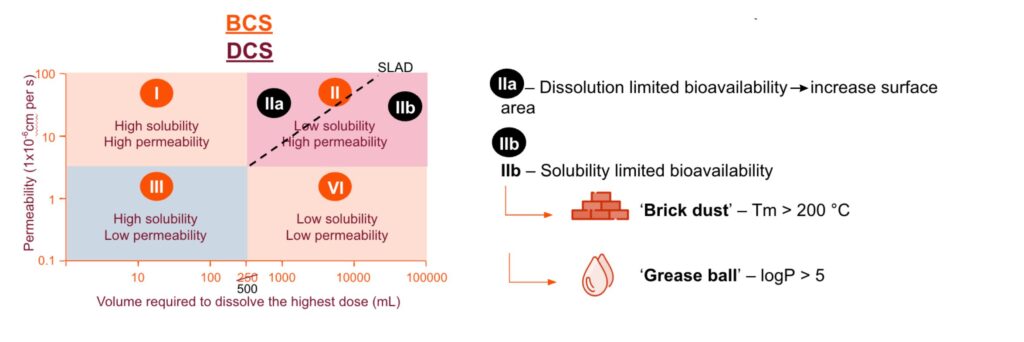
When a molecule crosses your desk as a “brick dust” (high melting point, Tm > 200 °C) or a “grease ball” (high lipophilicity, log P > 5), achieving optimal bioavailability becomes a primary formulation hurdle.
Traditional trial-and-error approaches no longer suffice in early-stage development. When optimizing solubility and bioavailability enhancement, formulation scientists face a critical crossroad.
Should you pursue chemical modifications, particle engineering, or complex carrier matrices? This article provides a high-level roadmap to help R&D teams evaluate these paths systematically without getting bogged down in single-technology tunnel vision.
The Nature of the Challenge: BCS Class II and IV Realities
Oral drug absorption depends heavily on dissolution rate and intestinal permeability. BCS Class II compounds feature high permeability but low solubility, meaning dissolution is the rate-limiting step for absorption. Conversely, Class IV compounds struggle with both low solubility and low permeability.
When evaluating poor aqueous solubility, physicochemical characterization is the mandatory first step. Understanding whether an API behaves as a “brick dust” or a “grease ball” provides valuable insight into the underlying causes of poor dissolution. Identifying these physicochemical characteristics early allows formulation teams to select the most appropriate enabling technology before development progresses too far.
A Strategic Roadmap to Enhance Bioavailability: From Salts to Enabling Technologies
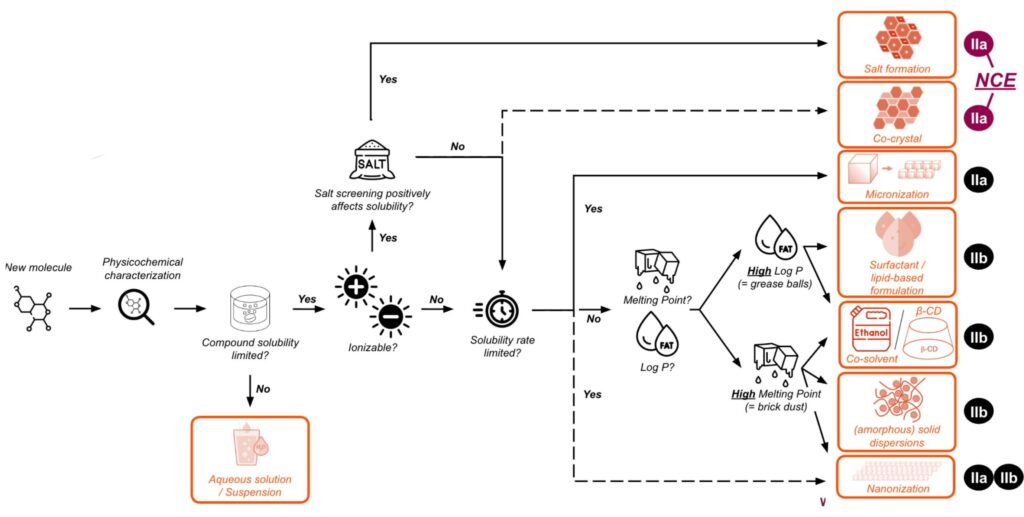
Rather than viewing salt formation, nanosuspensions, amorphous solid dispersions, and lipid formulations as competing technologies, experienced formulation teams treat them as decision points within a structured development roadmap. Early physicochemical characterization—including ionizability, dissolution rate limitation, melting point, and lipophilicity—helps determine which enabling strategy is most likely to succeed.
Parallel screening enables formulation teams to identify the most promising development path early while reducing the risk of pursuing suboptimal technologies.
1. Salt Formation and Co-Crystals
For ionizable molecules, salt screening is often the most powerful and relatively simple way to overcome poor performance. Selecting the correct counter-ion can drastically alter pH-solubility profiles, and salt or co-crystal selection can even enable new intellectual property (NCE protection). However, formulators must watch out for challenges like salt disproportionation driven by micro-environmental pH changes and relative humidity.
2. Particle Size Reduction
If salt formation is non-viable, reducing particle size increases the specific surface area, thereby accelerating the dissolution rate according to the Noyes-Whitney equation. Traditional micronization is widely used, but when extreme surface area is required, creating a nanosuspension can be the simplest and most effective solution. Utilizing wet media milling yields colloidal dispersions stabilized by polymers or surfactants to prevent agglomeration and Ostwald ripening.
3. Amorphous Solid Dispersions (ASDs)
When particle size reduction is insufficient for high-dose, low-solubility compounds, formulators turn to amorphous solid dispersions (ASDs). By molecularly dispersing the active pharmaceutical ingredient into a polymer matrix, the system bypasses the stable crystal lattice entirely, possessing high free energy that significantly drives up apparent solubility.
The success of an ASD relies heavily on two kinetic phenomena: the spring effect, where the amorphous form generates rapid supersaturation well above the crystalline equilibrium solubility, and the parachute effect, where polymers inhibit rapid recrystallization in gastrointestinal fluids. Depending on thermal stability, processability, drug–polymer compatibility, and overall product quality, teams choose between fusion methods like Hot-Melt Extrusion (HME) or solvent evaporation techniques such as spray drying.
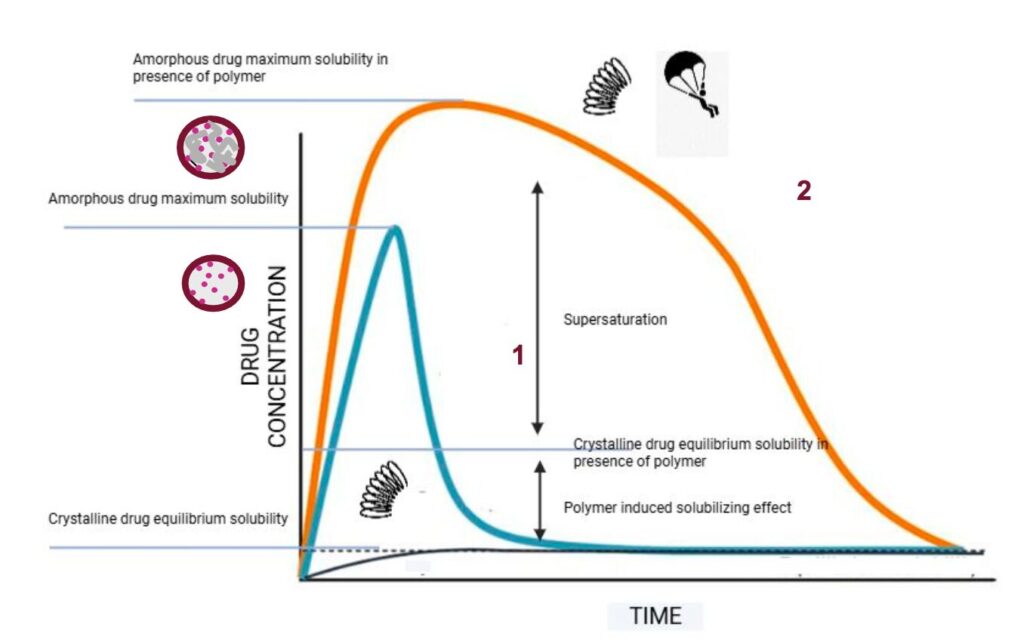
Key Takeaway: Whether you utilize lipid-based formulations, crystalline nanosuspensions, or amorphous solid dispersions (ASDs), success ultimately depends on maintaining the formulation’s intended physical state and stability throughout manufacturing, shelf-life, and in vivo transit.
Parallel Screening: Choosing the Right Formulation Strategy
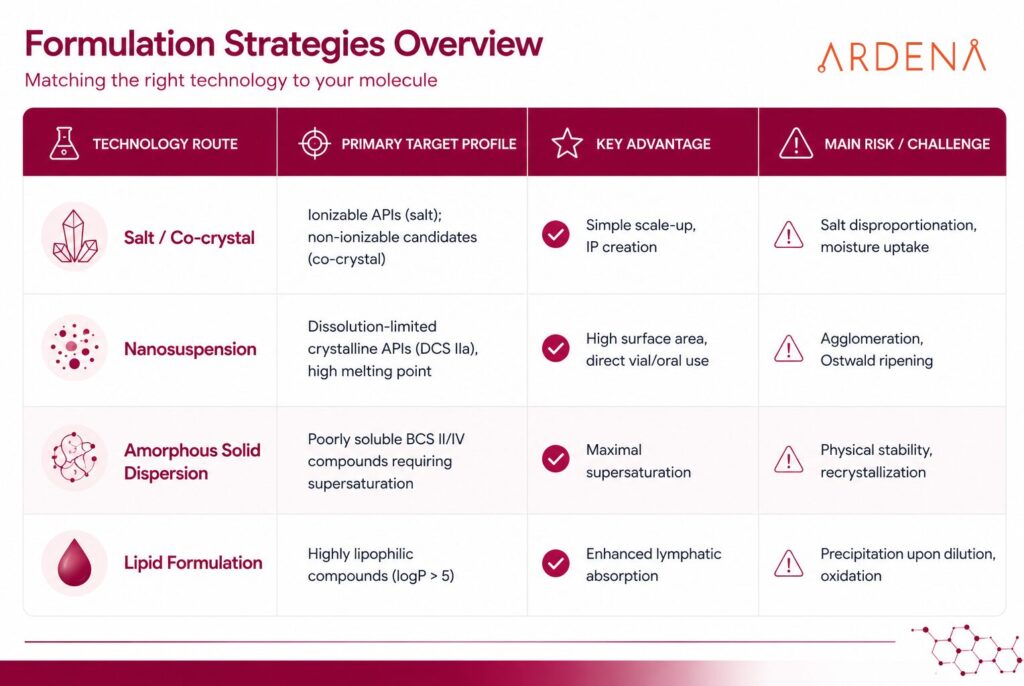
Because no single technology fits all molecules, an effective development strategy advocates for a parallel screening philosophy. By evaluating salt feasibility, lipid compatibility, and amorphous stability simultaneously during early pre-formulation, development teams de-risk the program early.
Conclusion
Overcoming poor bioavailability is rarely about finding a single “magic bullet” technology. It requires an integrated, science-driven roadmap that evaluates physicochemical properties, anticipates physical stability risks, and matches the API to the optimal enabling technology early in the development lifecycle.
Subject Matter Experts

Timothy Pas
AD, Formulation & Production
Dr. Timothy Pas is Associate Director, Formulation Development and Production at Ardena. He leads a team supporting formulation development and GMP manufacturing activities for early clinical programs. Since joining Ardena, Timothy has progressed from Formulation Scientist to Group Leader and currently Associate Director. Throughout his career at Ardena, he has developed extensive expertise in oral and parenteral formulations, formulation development strategies, and GMP manufacturing operations supporting early-stage pharmaceutical development programs. Timothy obtained a Master’s degree in Drug Development and earned his PhD in Pharmaceutical Technology from KU Leuven, specializing in enabling technologies and galenic principles.

Laure Descamps
Senior Formulation Scientist
Laure Descamps is Senior Formulation Scientist at Ardena, specializing in solid dosage development and process understanding. She supports formulation design, process optimisation, and early-phase drug product development for complex pharmaceutical programs. At Ardena, Laure applies her expertise to developing robust formulation strategies that support the efficient advancement of complex molecules toward clinical evaluation. Her work focuses on formulation development and process understanding across early-stage drug product development activities. Laure obtained her Master’s degree in Drug Development and Industrial Pharmacy and earned her PhD from Ghent University’s Laboratory of Pharmaceutical Process Analytical Technology. Her doctoral research focused on tabletting behaviour, material characterisation, and compression challenges in collaboration with industry partners.