

Bioavailability Enhancement: A Strategic Roadmap for Poorly Soluble Drug Candidates

The modern pharmaceutical pipeline is rich in highly potent, highly specific New Chemical Entities (NCEs). Yet, approximately 70% to 90% of new chemical entities and up to 40% of marketed drugs fall within BCS Class II or IV, reflecting the widespread challenge of poor aqueous solubility. 

When a molecule crosses your desk as a “brick dust” (high melting point, Tm > 200 °C) or a “grease ball” (high lipophilicity, log P > 5), achieving optimal bioavailability becomes a primary formulation hurdle.

Traditional trial-and-error approaches no longer suffice in early-stage development. When optimizing solubility and bioavailability enhancement, formulation scientists face a critical crossroad. 

Should you pursue chemical modifications, particle engineering, or complex carrier matrices? This article provides a high-level roadmap to help R&D teams evaluate these paths systematically without getting bogged down in single-technology tunnel vision.
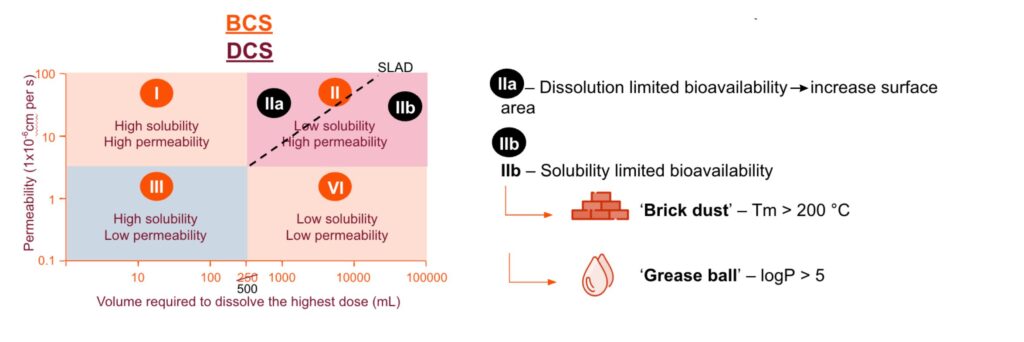
DCS classification matrix illustrating BCS Class II and IV drug challenges including brick dust and grease ball molecules

The Nature of the Challenge: BCS Class II and IV Realities

Oral drug absorption depends heavily on dissolution rate and intestinal permeability. BCS Class II compounds feature high permeability but low solubility, meaning dissolution is the rate-limiting step for absorption. Conversely, Class IV compounds struggle with both low solubility and low permeability.

When evaluating poor aqueous solubility, physicochemical characterization is the mandatory first step. Understanding whether an API behaves as a “brick dust” or a “grease ball” provides valuable insight into the underlying causes of poor dissolution. Identifying these physicochemical characteristics early allows formulation teams to select the most appropriate enabling technology before development progresses too far.
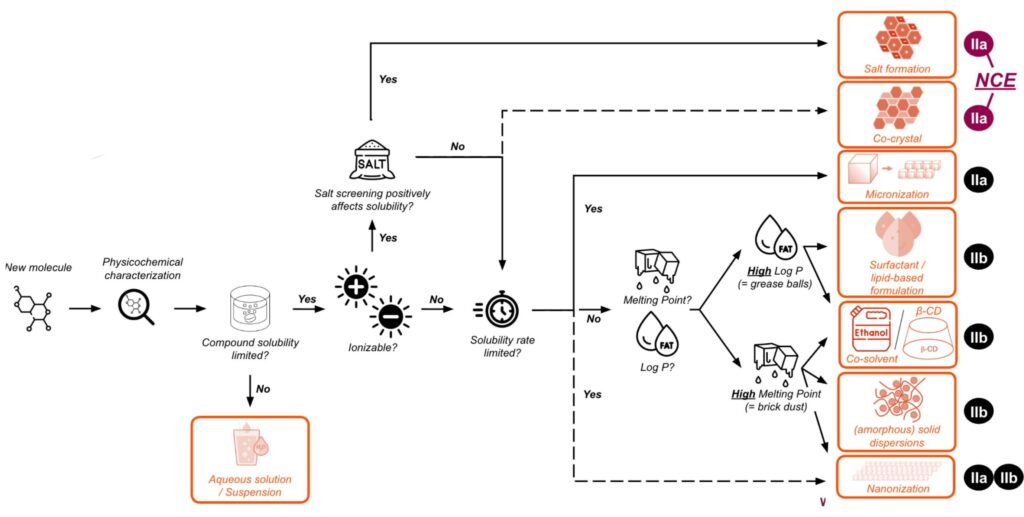
A Strategic Roadmap to Enhance Bioavailability: From Salts to Enabling Technologies

A Strategic Roadmap to Enhance Bioavailability: From Salts to Enabling Technologies

Rather than viewing salt formation, nanosuspensions, amorphous solid dispersions, and lipid formulations as competing technologies, experienced formulation teams treat them as decision points within a structured development roadmap. Early physicochemical characterization—including ionizability, dissolution rate limitation, melting point, and lipophilicity—helps determine which enabling strategy is most likely to succeed.

Parallel screening enables formulation teams to identify the most promising development path early while reducing the risk of pursuing suboptimal technologies.

1. Salt Formation and Co-Crystals

For ionizable molecules, salt screening is often the most powerful and relatively simple way to overcome poor performance. Selecting the correct counter-ion can drastically alter pH-solubility profiles, and salt or co-crystal selection can even enable new intellectual property (NCE protection). However, formulators must watch out for challenges like salt disproportionation driven by micro-environmental pH changes and relative humidity.

2. Particle Size Reduction

If salt formation is non-viable, reducing particle size increases the specific surface area, thereby accelerating the dissolution rate according to the Noyes-Whitney equation. Traditional micronization is widely used, but when extreme surface area is required, creating a nanosuspension can be the simplest and most effective solution. Utilizing wet media milling yields colloidal dispersions stabilized by polymers or surfactants to prevent agglomeration and Ostwald ripening.

3. Amorphous Solid Dispersions (ASDs)

When particle size reduction is insufficient for high-dose, low-solubility compounds, formulators turn to amorphous solid dispersions (ASDs). By molecularly dispersing the active pharmaceutical ingredient into a polymer matrix, the system bypasses the stable crystal lattice entirely, possessing high free energy that significantly drives up apparent solubility.

The success of an ASD relies heavily on two kinetic phenomena: the spring effect, where the amorphous form generates rapid supersaturation well above the crystalline equilibrium solubility, and the parachute effect, where polymers inhibit rapid recrystallization in gastrointestinal fluids. Depending on thermal stability, processability, drug–polymer compatibility, and overall product quality, teams choose between fusion methods like Hot-Melt Extrusion (HME) or solvent evaporation techniques such as spray drying.
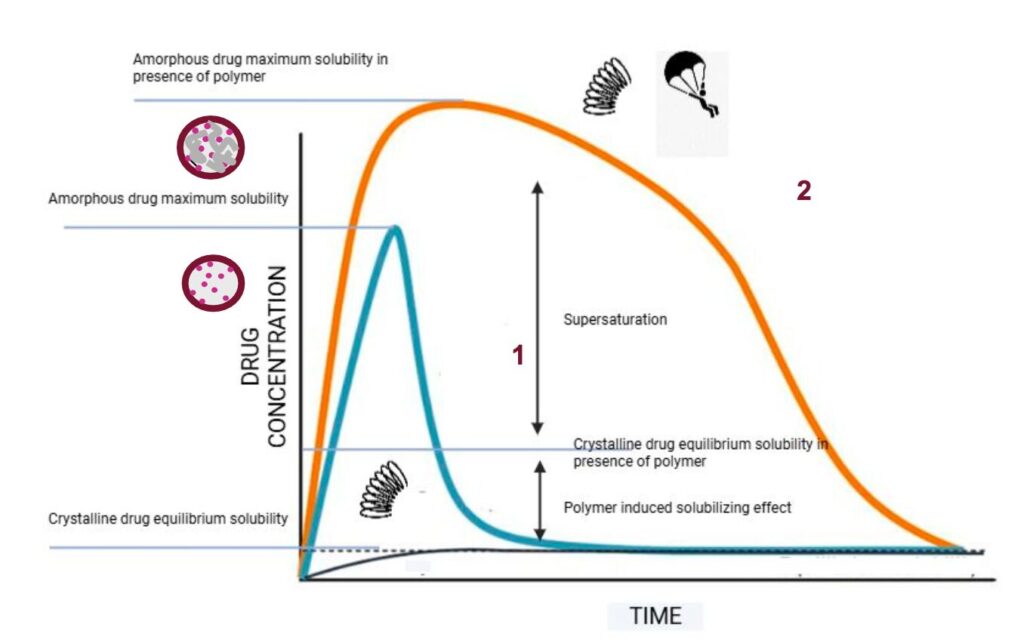
Graph showing the spring and parachute effect of amorphous solid dispersions driving supersaturation and preventing recrystallization

Key Takeaway:  Whether you utilize lipid-based formulations, crystalline nanosuspensions, or amorphous solid dispersions (ASDs), success ultimately depends on maintaining the formulation’s intended physical state and stability throughout manufacturing, shelf-life, and in vivo transit.

Parallel Screening: Choosing the Right Formulation Strategy

Because no single technology fits all molecules, an effective development strategy advocates for a parallel screening philosophy. By evaluating salt feasibility, lipid compatibility, and amorphous stability simultaneously during early pre-formulation, development teams de-risk the program early.
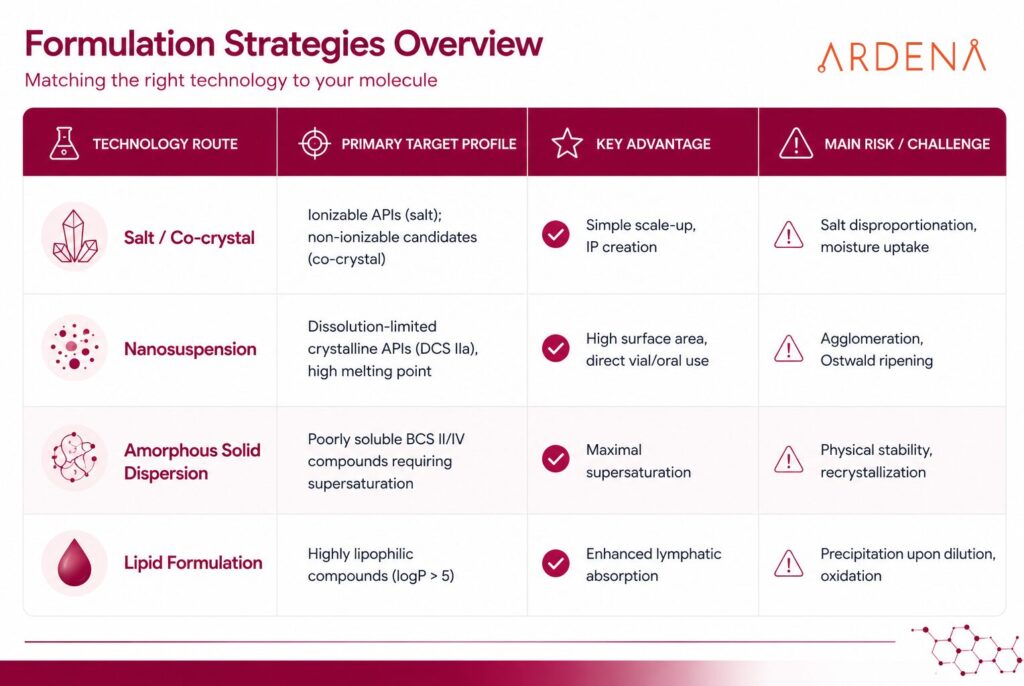
Comparison table of formulation strategies including salt selection, nanosuspensions, ASDs, and lipid formulations with key advantages and risks

Conclusion

Overcoming poor bioavailability is rarely about finding a single “magic bullet” technology. It requires an integrated, science-driven roadmap that evaluates physicochemical properties, anticipates physical stability risks, and matches the API to the optimal enabling technology early in the development lifecycle.

AI in Drug Development: The Confidentiality Challenge Facing CDMOs

As molecular complexity continues to increase, pharmaceutical companies are increasingly turning to AI in drug development to predict and optimize critical properties such as solubility and bioavailability. By identifying patterns in chemical data, AI can estimate parameters such as pKa and logP, as well as predict formulation-dependent effects on absorption. 

These capabilities allow for more informed formulation development, potentially reducing the need for extensive laboratory experiments. However, within the CDMO landscape, this technological momentum is constrained by a significant confidentiality barrier.

The Challenge of Data Confidentiality

While the potential for AI is immense, CDMOs face unique hurdles. Client-owned molecular structures cannot simply be uploaded to public or cloud-based AI platforms without risking intellectual property. This creates a fundamental tension between AI capability and compliance.

Developing secure, in-house AI platforms may appear to be a natural solution, yet this approach introduces additional complexities. High-performance models depend on large, heterogeneous datasets, which in a CDMO environment inevitably consist of multiple client molecules. 

This raises challenging questions around data ownership and the risk that proprietary features become embedded within shared models. Even when structures are anonymized, the risk of reverse identification remains.

Moreover, internal AI models must be validated against real molecular data. Without explicit client authorization, rarely granted under standard MSAs, project compounds cannot be used for model training or benchmarking. This constraint slows model maturation and limits the immediate value of internally developed AI tools, despite significant investment.

Explainable AI in Drug Development and the Need for Validation

Even where advanced AI platforms are accessible, their outputs should be treated as hypothesis-generating rather than definitive. Solubility and bioavailability are governed by complex, context-dependent interactions that cannot yet be resolved computationally alone. 

Furthermore, the “black-box” nature of many AI systems limits their standalone credibility because predictions lacking mechanistic justification fail to meet established evidentiary standards.

As a result, there is growing interest in explainable AI in drug development (xAI) approaches, which aim to improve transparency and interpretability. While these technologies may strengthen confidence in AI-generated predictions by offering better insight into model logic, they do not eliminate the need for human scientific oversight. Formulation scientists continue to play a critical role in evaluating AI outputs, identifying potential biases, and designing targeted experiments to confirm or refute computational predictions.

A Future Where AI Supports Formulation Science

As we move into the Pharma 4.0 era, AI is expected to play an increasingly important role in pharmaceutical development. Emerging technologies that protect data sovereignty, alongside maturing regulatory expectations, may help overcome existing hurdles.

Ultimately, AI is likely to enhance scientific decision-making by directing scientists toward more promising and sophisticated development strategies. Nevertheless, empirical testing of predicted solubility, bioavailability, and overall product performance remains indispensable. 

AI models should be viewed as predictive tools that require validation, rather than a substitute for laboratory science. When applied judiciously, AI has the potential to expedite development timelines by enabling more efficient allocation of formulation resources, thereby reducing time-to-market.

References

  1. Ann M. Thayer, “Finding solutions: Custom manufacturers take on drug solubility issues to help pharmaceutical firms move products through development” (2010).
  2. Zeqing Bao et al., “Towards the prediction of drug solubility in binary solvent mixtures at various temperatures using machine learning” (2024). Available at: https://link.springer.com/article/10.1186/s13321-024-00911-3
  3. Sanjay Konagurthu, Thermo Fisher Scientific, “Revolutionizing drug development: AI-driven solutions for poor solubility and bioavailability” (2024). Available at: https://www.patheon.com/us/en/insights-resources/blog/ai-driven-drug-development-for-poor-soubility-and-bioavailability.html
  4. Alessio Zoccoli et al., Drug Target Review, “Making sense of AI: bias, trust and transparency in pharma R&D” (2025). 
  5. Jirapornchai Suksaeree, “A review of artificial intelligence (AI)-driven smart and sustainable drug delivery systems: A dual-framework roadmap for the next pharmaceutical paradigm” (2025). Available at: https://www.mdpi.com/2413-4155/7/4/179
  6. Sanjay Konagurthu, European Pharmaceutical Review, “Applying AI to enhance drug formulation and development” (2026). 
  7. FDA and EMA, “Guiding principles of good AI practice in drug development” (2026). Available at: https://www.fda.gov/about-fda/artificial-intelligence-drug-development/guiding-principles-good-ai-practice-drug-development

Advancing Nanomedicine: What to Expect at the ‘Nanomedicine & Bioconjugation Symposium 2026’

In the complex world of nanomedicine, staying ahead of analytical challenges is a core focus of our work at Ardena. We are looking forward to taking this conversation further at our upcoming ‘Nanomedicine & Bioconjugation Symposium 2026this September.

As an organization, our guiding principle is “We Know Nano™,” reflecting our deep-rooted expertise in navigating the intricate challenges of nanomedicine development. Ardena’s first nanomedicine symposium brings together leading scientists, clinicians, and industry experts to discuss the latest advances in nanomedicine.

Over two days in Oss, The Netherlands, you will have the opportunity to hear from and engage directly with international key opinion leaders, industry innovators, and our own team of experts. 

We are proud to feature speakers such as Dr. Christian Schröter (COO & Managing Director, Topas Therapeutics GmbH), who shares our vision for the event:

“I am looking forward to engaging with industry innovators and international leaders on the future of nanomedicine. It is a pleasure to contribute to these discussions. Thanks to the entire team at Ardena for organizing such a significant event that addresses our shared scientific challenges.”

The symposium is designed for C-level executives, CMC experts, and senior scientists from biotech, pharma, and academia who are navigating the evolving landscape of complex drug development. Our speaker panel focuses on four critical pillars of modern nanomedicine:

  • Nanomedicines in clinical development
  • Bioconjugation
  • mRNA / LNP formulation strategies
  • Analytical characterisation of complex modalities

Whether your work involves navigating regulatory hurdles, refining formulation strategies, or mastering advanced analytical characterization, this symposium offers a unique platform to exchange knowledge and gain practical insights.

Beyond the sessions, attendees will also have the exclusive opportunity to tour Ardena’s specialized nanomedicine facility, providing a first-hand look at the integrated workflows that drive successful development.

Join us in Oss on 15-16 September 2026.

Register for the ‘Nanomedicine & Bioconjugation Symposium 2026’ here

Bridging the Development Gap: Why an Integrated CDMO is Critical for Early Phase Drug Development

In a recent industry roundtable hosted by 24/7 Biopharma, a panel of leaders examined how rising molecular complexity and shifting market dynamics are reshaping the drug development landscape (link to the article). Among the key takeaways, Henny Zijlstra, CCO at Ardena, highlighted that for biotech companies, success depends on partnering with an integrated CDMO to bridge the widening gap between scientific ambition and development reality.

For many biotech companies, the pressure to reach the clinic is higher than ever, yet the molecules themselves are becoming increasingly complex. In this environment, navigating early phase drug development requires more than just raw capacity, it demands a different approach to strategy and execution.

The Trap of Linear Handovers

Zijlstra pointed out that a primary cause of delay and budget inefficiency is the traditional, linear view of development. Many programs are still treated as a series of handovers between functions: from solid-state chemistry to formulation, then to manufacturing, and finally to bioanalysis.

This model inevitably creates gaps. According to Zijlstra, the most successful programs are those that break this linear cycle. Instead of shifting a molecule from one functional silo to the next, companies benefit from a model where formulation strategy, analytical insight, and regulatory thinking are connected from day one. This is where an integrated CDMO becomes a vital partner, ensuring that decisions are not made in isolation but are informed by continuous scientific dialogue.

Development Judgement over Speed

While speed is a common goal in the industry, Zijlstra warned against “moving fast without technical purpose.” Generating data quickly is useless if that data does not support the next critical decision.

A truly effective CDMO partnership is defined by the ability to help clients see around corners – identifying where technical or regulatory risk is likely to appear before it becomes a bottleneck. Whether a program requires rapid enabling work to reach the clinic or a deeper investigation into solubility, stability, or delivery technology, the priority must be protecting capital and timelines by making the right choices at the right stage.

Integrating Bioanalytical CRO Expertise

The complexity of modern modalities, such as lipid-based systems or complex injectables, requires a deep connection between formulation and measurement. Zijlstra highlighted that innovation is not about one technology in isolation, but about the ability to turn complex science into better development decisions.

This requires an integrated CDMO and bioanalytical CRO capability that works in concert. At Ardena, our approach is built on the philosophy that ‘we know bioanalysis’, not as a separate service line, but as a critical data stream that informs every development decision.
By aligning bioanalytical data with formulation strategy, teams can see patterns earlier, compare outcomes more effectively, and capture knowledge across workstreams. For biopharma companies, this integrated approach creates practical value: it ensures the work being done consistently supports the next regulatory or partnering milestone.

Conclusion

The core message shared by Zijlstra is that complex molecules need more than capacity, they need development judgement. Protecting a product’s potential in the early stages requires a plan that is technically sound, stage-appropriate, and built on continuous scientific integration. As the industry continues to evolve, the focus must remain on connecting the scientific dots to turn potential into clinical reality.